Blog

The North American Political Animal

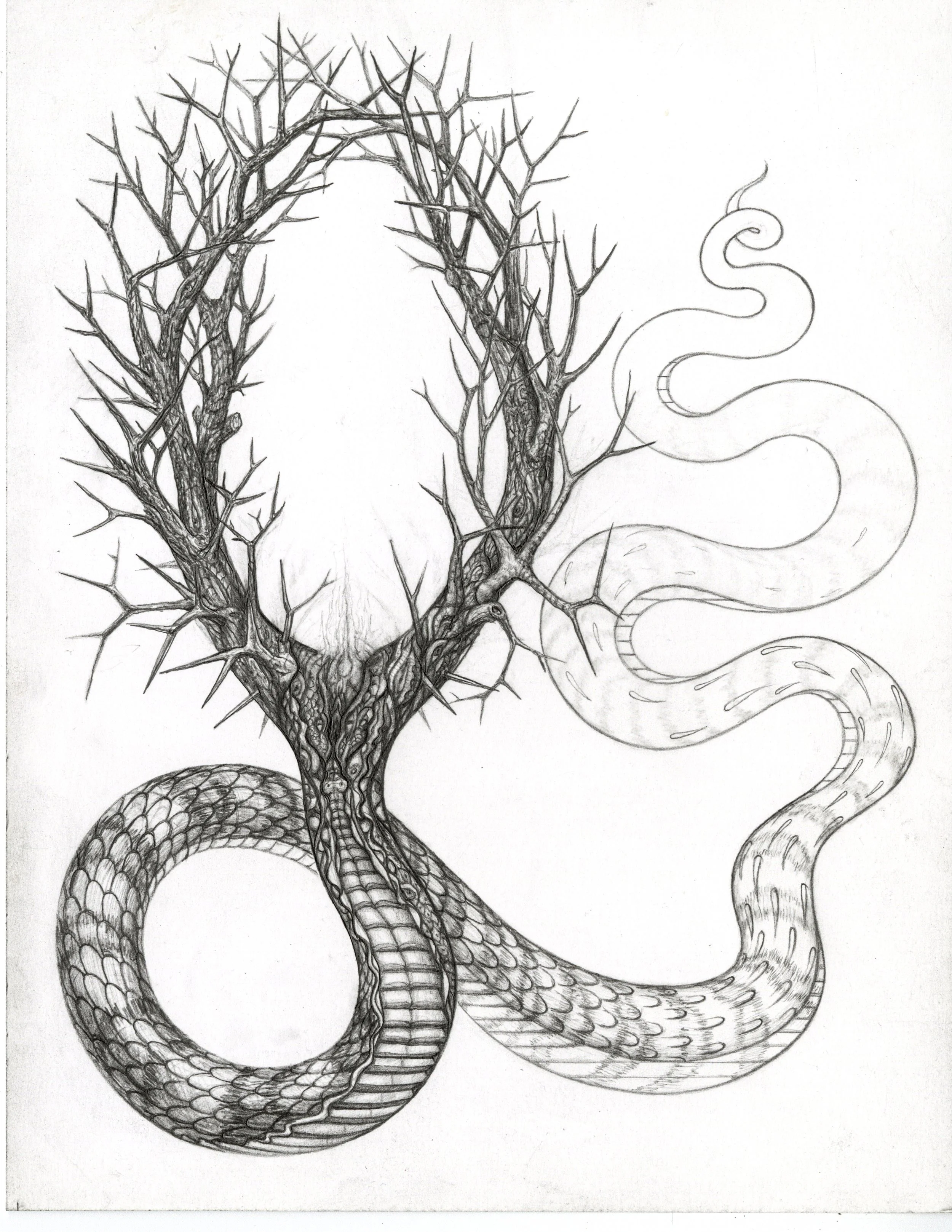
2025 Study #1 for The Postmodern Tree of Knowledge. Graphite on paper

I have been working on a series of images called The Postmodern Tree of Knowledge. The series began slowly and has evolved into a way to visualize a change I see in myself and in the culture around me: the shift from knowledge as something meant to nourish wisdom, toward knowledge as something increasingly used to secure power. I wanted a symbol that could hold both the inheritance of older sacred structures of meaning and the modern impulse to question, dismantle, and remake them.
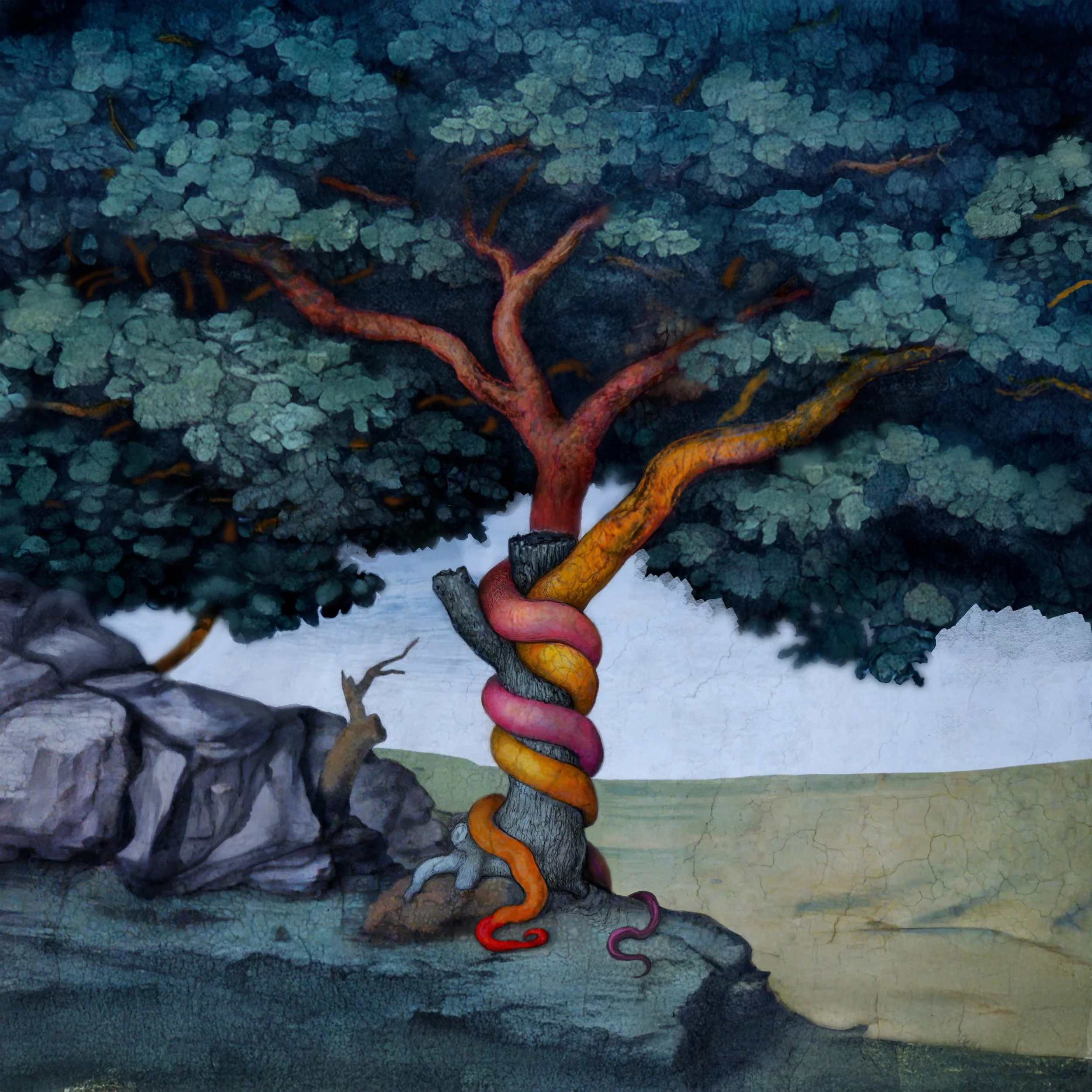
Digital Sketch For The Post Modern Tree of Knowledge. 2026 If this looks familiar, follow this link https://commons.wikimedia.org/wiki/File:Adam_and_Eve,_Sistine_Chapel.jpg

For most of human history, people pictured reality as a world tree—a living structure with direction and consequence. Its branches spread outward and upward toward the future, toward heaven, toward what we hope is higher than us. Its roots spread downward and outward into the past, into what is buried, feared, and foundational. In this image of reality, knowledge is not just information. It is supposed to grow into judgment, restraint, and responsibility. The Tree of Knowledge, in particular, becomes a picture of discernment: the human task of learning the difference between good and evil, true and false, and living as though those differences matter.

But modern critique—especially postmodern critique—complicates that tree. It asks necessary questions: Who benefits from the stories we call “truth”? What do inherited narratives conceal? What do they exclude? What happens when institutions use “knowledge” to protect themselves rather than to serve what is real? In that sense, critique can be accurate and corrective. It exposes hypocrisy, unmasks coercion, and refuses to let authority hide behind sacred language.

In my series, the tension begins when critique stops being a tool and becomes the ground itself—when the roots are treated as endlessly suspect and nothing remains stable enough to orient life. When foundations are perpetually destabilized, knowledge can become unmoored from wisdom. It becomes strategic. It becomes something we use rather than something we answer to. The question shifts from “What is true?” to “What works?” or “What wins?” The tree still stands, but it no longer feeds life in the same way.
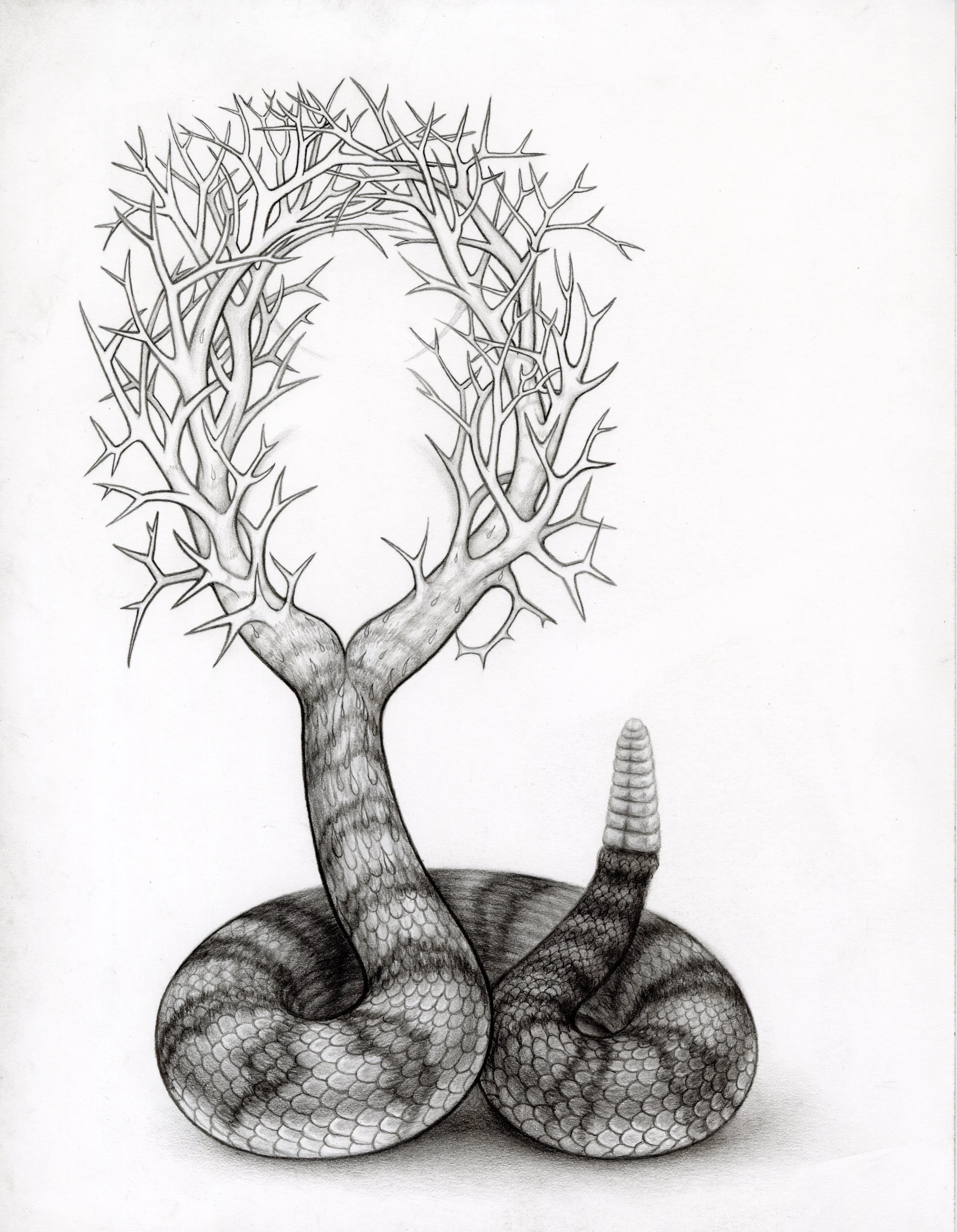
2025 Study #2 for The Postmodern Tree of Knowledge. Graphite on paper

That is where the snake enters the Postmodern Tree of Knowledge. The snake is not simply “evil” in my work. It is intelligence in motion: adaptive, alert, quick to respond, difficult to grasp. It can represent the necessary mind of critique; the mind that notices contradictions, exposes hidden motives, and refuses naive trust. But the snake also represents the danger of mind without higher orientation: intelligence that can justify anything, a reasoning that can twist truth when fear or desire takes over. The snake is what happens when movement replaces rootedness, when cleverness replaces wisdom, when suspicion replaces discernment.

The Snakehammer is the product of that transformation. It is a creature formed from the remains of the tree; knowledge hardened into a tool. The hammer’s wooden head implies that what once grew toward understanding has been cut down and repurposed. The serpent body implies a new kind of “root”: restless, evolving, unpredictable. The result is not a tree that bears fruit, but an instrument that strikes.
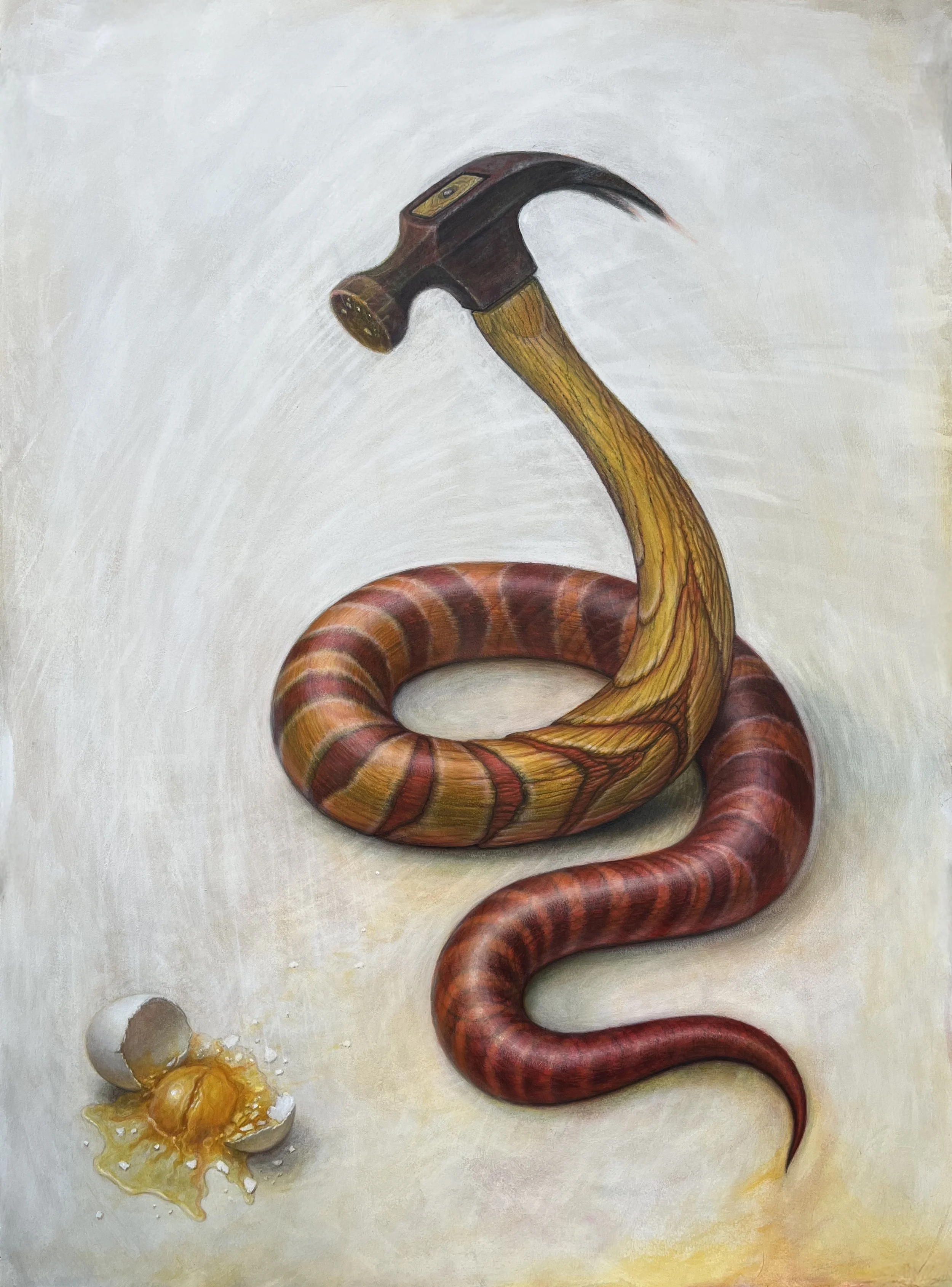
2025 The North American Political Animal, Acrylic and charcoal on paper

In The North American Political Animal, the Snakehammer sits poised above a broken egg. The egg is potential: ideas, families, communities, a future not yet formed. The image is not meant as a partisan accusation. It is a confession of unease; about what happens when strength is no longer guided by compassion, when conviction hardens into aggression, when the will to protect becomes the impulse to destroy. I recognize that drift in myself, and that recognition is frightening.

This painting is my attempt to give that problem a body; an image that can be seen and felt before it is argued about. It asks what kind of knowledge we are growing, what kind of power we are building, and what happens to the fragile future beneath us when the tool replaces the tree.

Can Someone Please Help Me Find My Grenade? (Nevermind)

4sketches.jpg

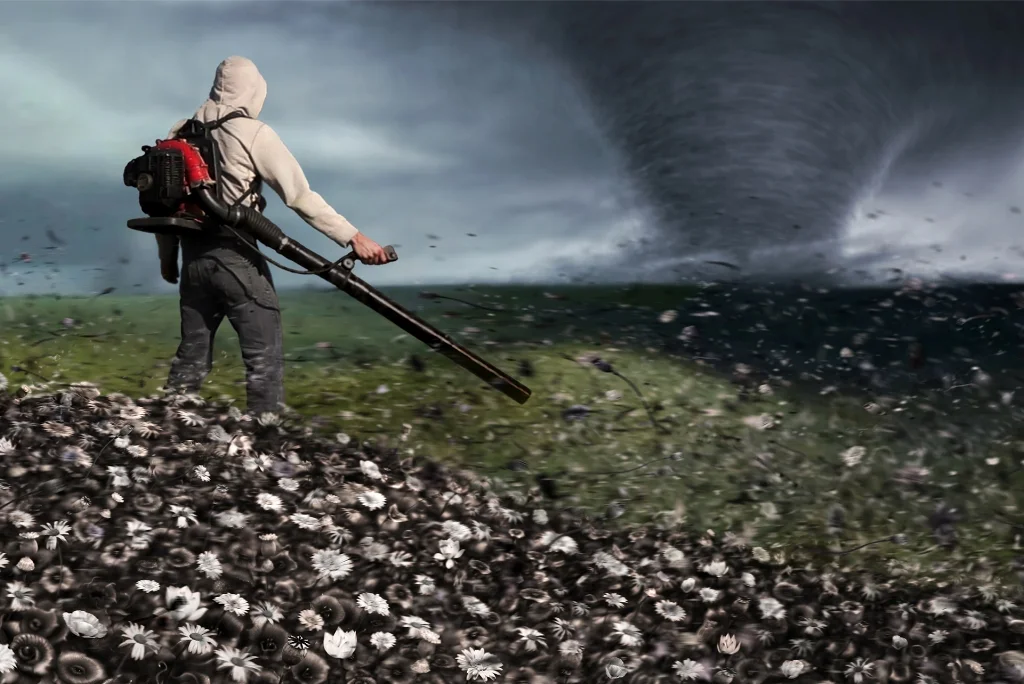
In early 2015, I made a little doodle on a scrap of paper (above left). It was a picture of boy wearing a hoodie that had just pulled a pin on a grenade. I thought of him as Icarus Elck, a character I created. You can read about him here 🌪️🌪️🌪️. Even though it was not a very good drawing, there was something about it I liked. So I scanned it and began drawing on it with my 13" Wacom Cyntiq using Photoshop. I took some reference pictures of myself in the same pose (see above lower right).

angelsketch.jpg

I was not happy with the drawing of the butterfly, so I removed it. This first image represented the will to act.

I wanted the hoodie character to be an "Everyman" or everyone (androgynous) character. I integrated the Leonardo Study Of An Angel into my drawing. For me, that angel represented the feminine aspect of the character as well as suggested that this person was not just simply evil and/or malevolent.

PPUnibomber2.jpg

I slowly introduced color.

Despite the comment above, I was jokingly calling this character the Unabomber because when I wore a hoodie and sunglasses, I resembled the UNABOMBER sketch.

bombertornado.jpg

I wanted to emphasize the character's psychological turmoil so layered the image with a tornado painting I had done (Above right).

Then I reintroduced the butterfly. For me, the butterfly represents the liminal space between idea and action. It is the pause for reflection and is the conscious moment of awareness. It is also the symbol of transformation and, obviously refers to the title The Butterfly Effect.

I worked on several more images in which I tried to really exaggerate the severity of the psychological turmoil Icarus Elck was experiencing. I was getting frustrated with this series and the world around me.

At the time I was making the version above, I was seriously questioning the sanity of about half of my fellow Americans. In 2015 and 2016 I was not able or even willing to try to understand their motivations and actions. The color in the image above represents that overwhelming anger and rage.

acceptance scott eagle

I felt like there was a beast welling up inside of me, and I digitally modified an acrylic painting of mine originally inspired by Jeff VanderMeer’s book called Acceptance (pictured above left), to represent that idea. Acceptance reminded me of the parasitoid stage of the xenomorph in the movie Alien. It also reminded me of the red knight in the movie The Fisher King and the vagina dentata in the movie Teeth.

butterflywing.jpg

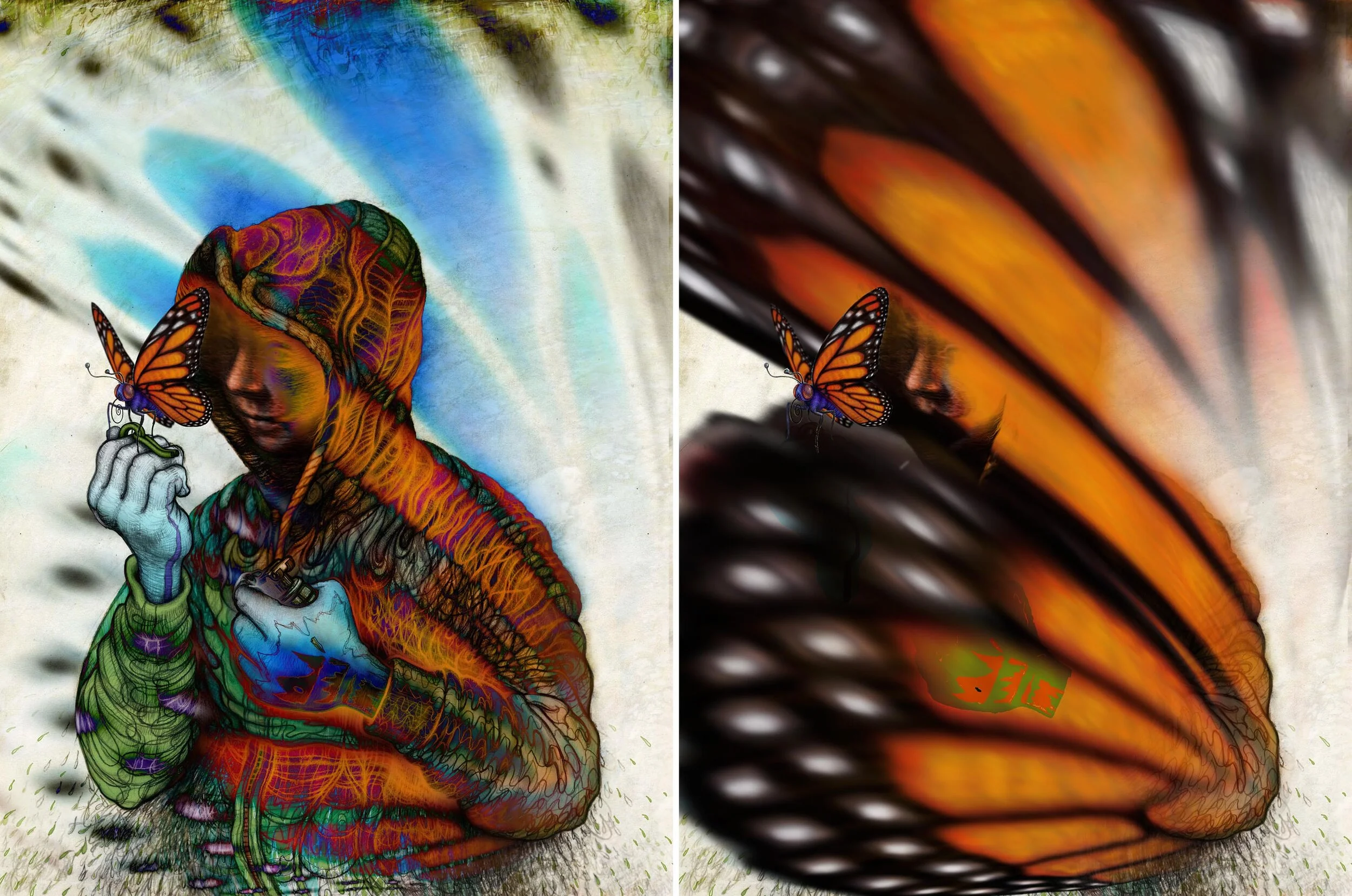
As women marched on Washington, I imagined a grenade exploding into millions of butterflies with razor blade wings. I wanted to create a beautiful explosion and stumbled onto the effect pictured above left by inverting the butterfly wing layer, which made it almost unrecognizable. The image above right is that same layer switched back to normal.

PPUnibomber7.jpg

I taught myself to use Photoshop and frequently have students tell me “You know that there is an easier way to do that right?”. But I just play around until I get the effect I want or stumble onto something better.

In the image above I was trying to digitally destroy part of the image when I accidentally used the sharpen tool too many times. The effect was hideous but interesting, so I kept doing it - for about a half an hour. Really. The right hand side of the image above was the result.

PPUnibomber8.jpg

I then inverted the image to explore the idea of a literal visual opposite.

PPUnibomber9.jpg

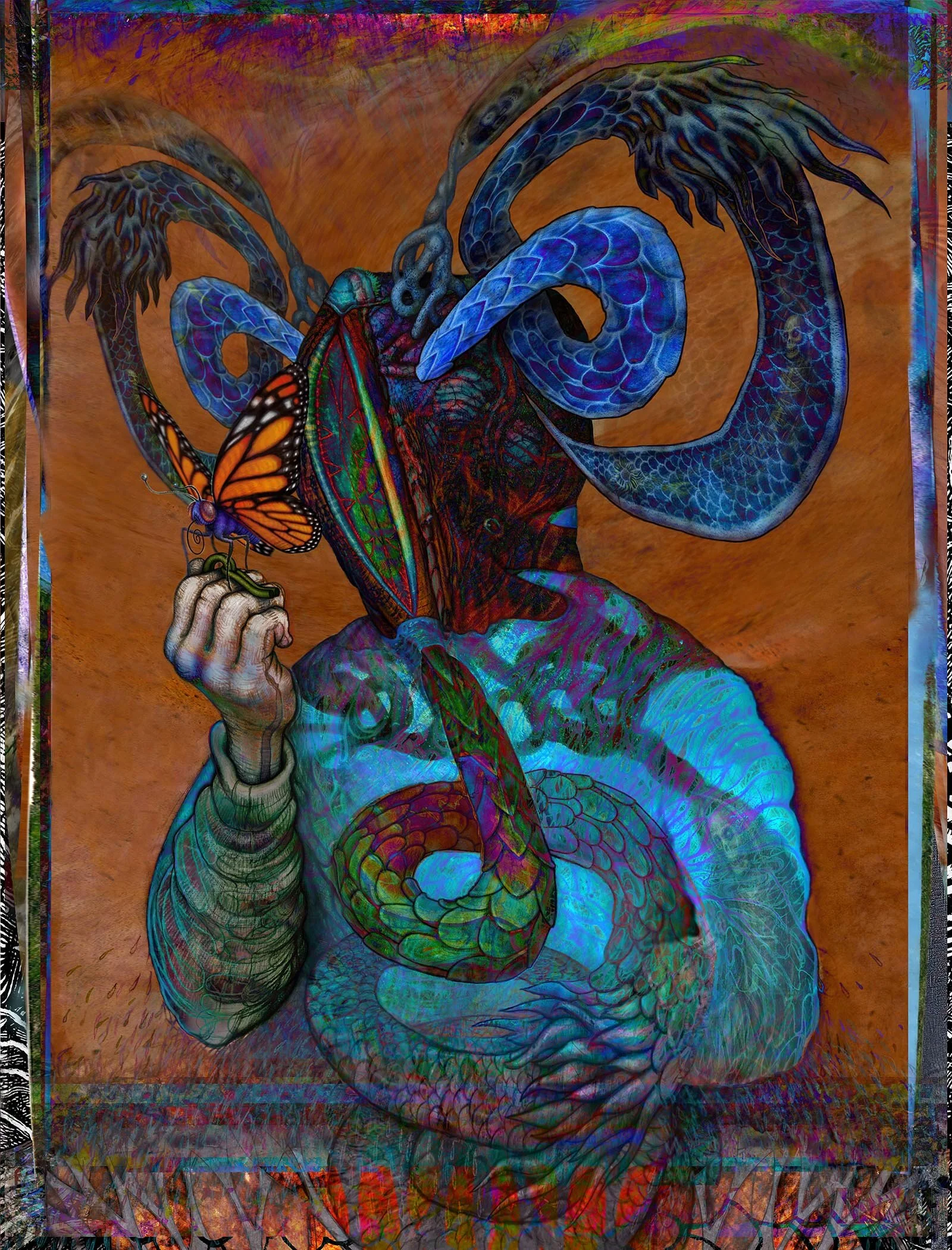
One day, I happened to turn off a layer and, forgetting the Acceptance image was in the stack, produced the image above. That little "accident" took me in a direction I had not intended. The new shape had become a "headdress" or mask through which my character experienced the world.

I spent a lot of time separating the “Beast Priest” from the background and the image above is the point at which I realized I had forgotten about the grenade.

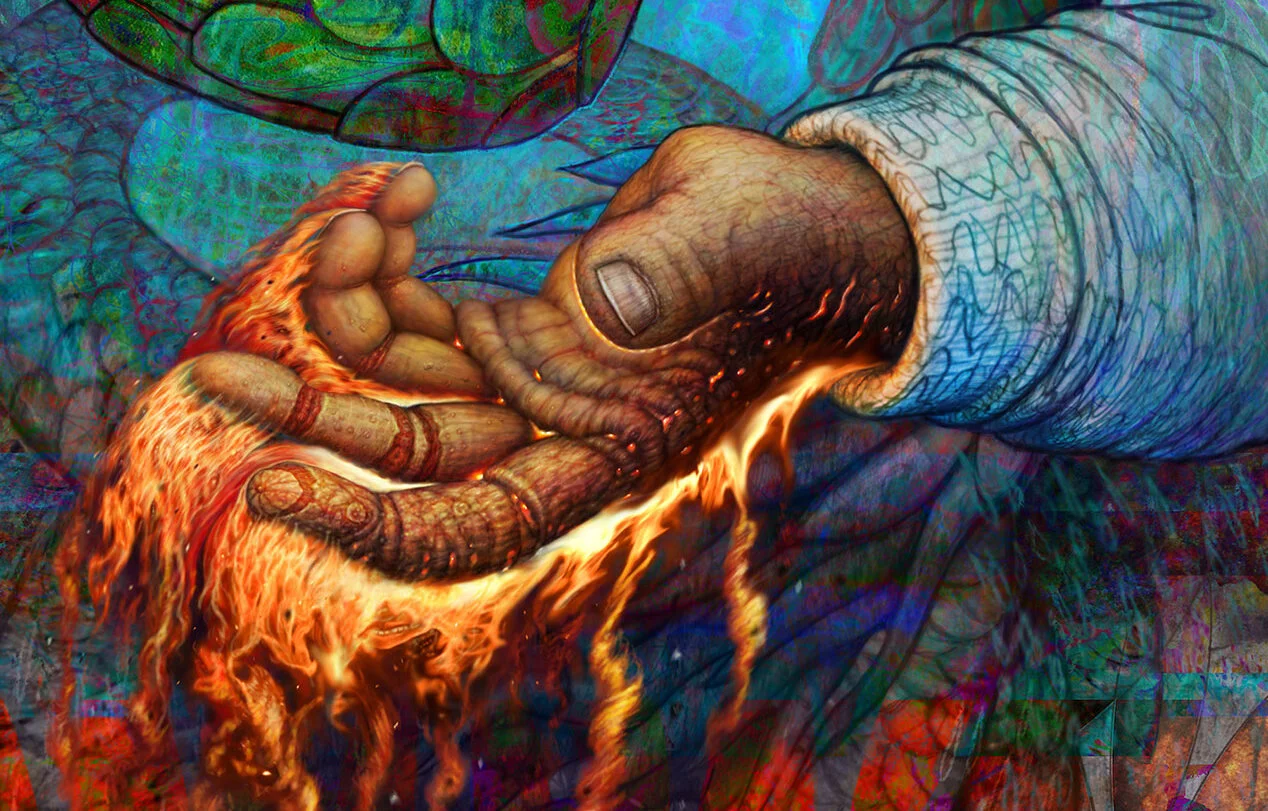
In most of my images, I work intuitively and spontaneously like doodling. For some reason I decided that the grenade was just gone and the hand would be on fire.

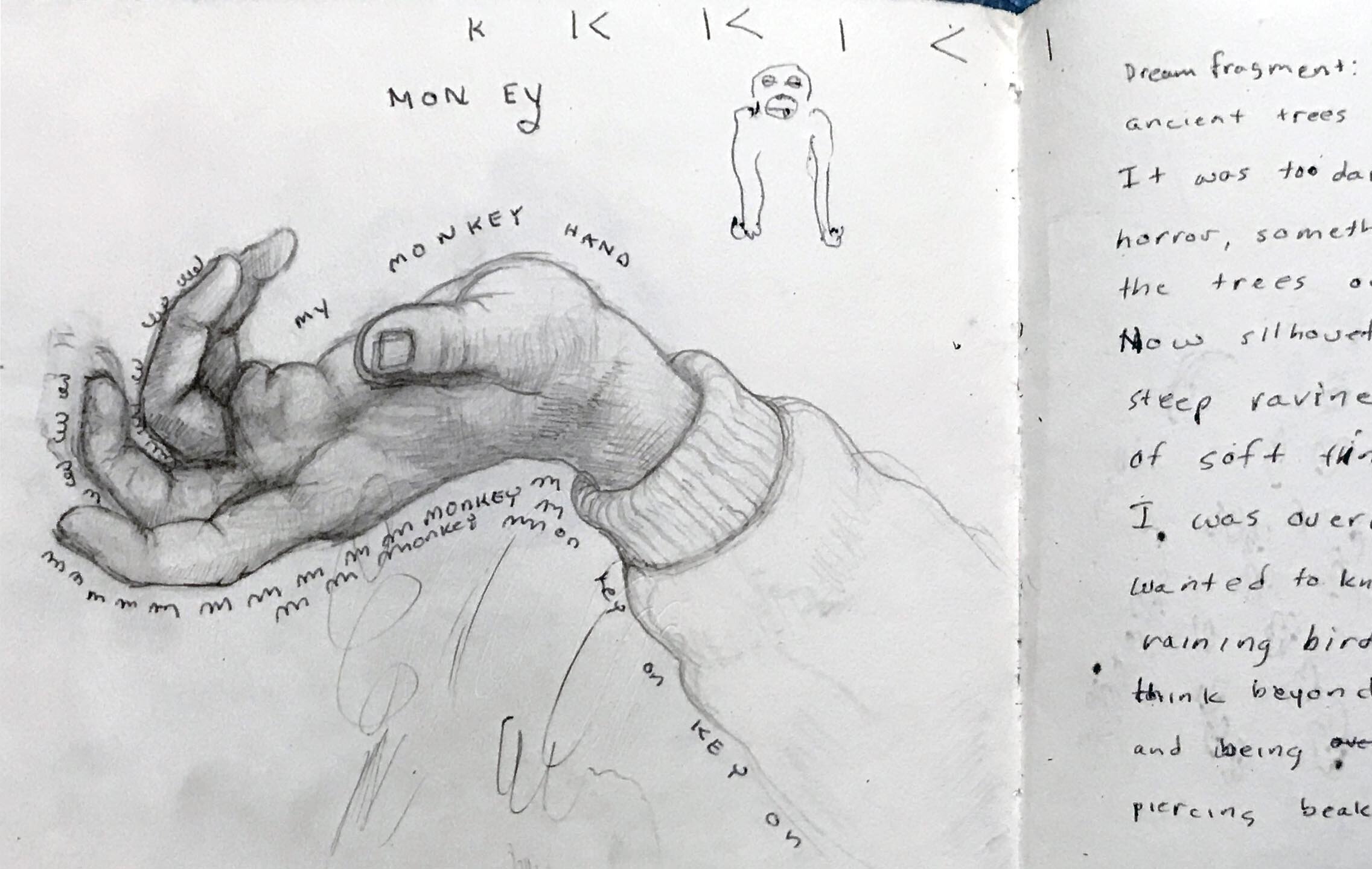
I used the sketchbook image (above left) as the starting point for the hand.

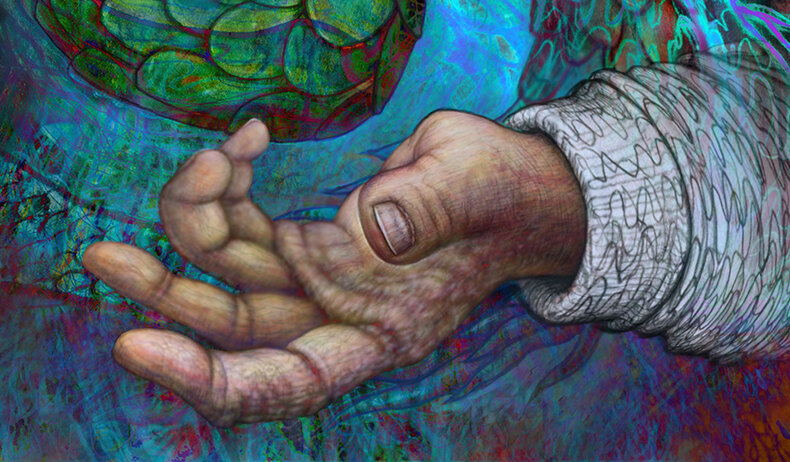
I digitally painted it. Click the image above to see the painted hand without fire and the right hand image with fire.

skeletons.jpg

I placed skeletons like the ones above inside the body of the Beast Priest.

I finished this image, but realized that as a series, these images did not flow in a logical manner.

My mother died December 23, 2016. You know what happened after that. The next 4 years were insane and I worked very little on these. Then Covid happened, my father died August 15, 2020, the Capitol was attacked, and finally, my marriage unraveled and I was divorced July 11, 2023.

Exactly one year later, I decided to find the grenade.

The creation of anything implies that there was an impetus or problem. Why would you make anything (a song, a law, a spaceship, a Mr. Potato Head Doll, even a doodle), if there was no cause.

I am trying to understand my place in this crazy world, and the images I create are my way of thinking through making instead of thinking through words in my head.

When I began this image, I thought I knew what it was about. I would tell people that Icarus Elck represented each of us. Icarus is the fallen son. In Dutch Elck means 'each' or 'everyone'. In the christian world view, which we have inherited, we are each fallen.

I would say that the butterfly represents a moment of clarity. The butterfly is an awakening. The butterfly is a full stop. Stop what you are doing. Stop what you are obsessing about. The butterfly represents change. The butterfly is the point of no return.

Do we blow ourselves up, or do we put the pin back in the grenade?

After many years of thinking about this (because I am a bit slow), I cannot honestly say that this image represents everyone. I could not possibly know what anyone else really thinks.

This series of images represents me. I am Icarus Elck. I am the fallen son. I am just another human being like you (I hope : ).

And the grenade? It was not for destroying others. The grenade was meant for me. And that is the what the painting below represents.

I am Scott EAGLE and this painting is titled I AM THE PHOENIX.

WHEN I PAINTED MY FIRST MURAL, I NEVER THOUGHT I WOULD END UP IN CHINA

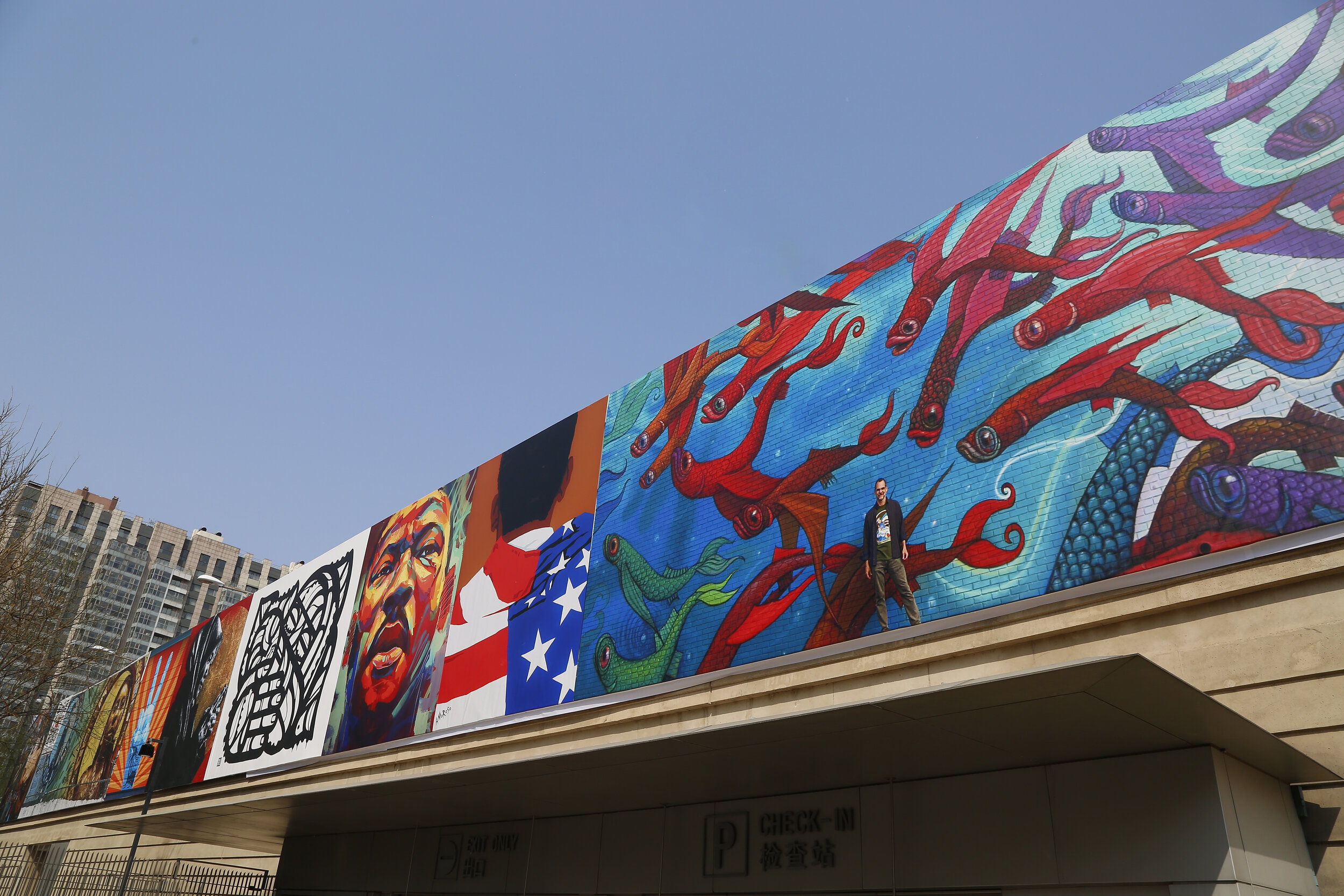
In September of 2020 I started painting my first mural. The wall was 56 feet long by 17 feet tall on the side of the ARTLAB building in Greenville, NC. I teach painting and drawing and have had many students go on to do amazing things, including become muralists. How hard could it be, right?

It almost killed me.

I had planned on thoroughly documenting my Quixotic endeavor here with the necessary sober and academic rigor required, as I have done on Facebook. But like everything in 2020 and 2021, events have taken a very unusual turn. In fact, five minutes before I made the video above about bubbles and finishing a mural and not dying, photographer Ryan O’neal Harper just happened to walk by and take the picture that you see before you start the video.

Behind the scenes (on Facebook) Sanny Wroblewski had contacted me to ask if I was interested in having this mural reproduced and exhibited in Beijing, China. Since I have been alive a very long time, I have had lots of people tell me that they were going to pay me buckets of money and make me famous. I told Sanny what I tell everyone that has an amazing opportunity — Of course! But, I never get my hopes up because, I am not famous, but I do have a jar of quarters.

Anyway, Sanny continued to contact me with details and started including other people, so I started paying attention. She then asked me to send a photo of the mural. At that time, the only high quality photo I had was Ryan’s singular amazing shot, so that is what I sent.

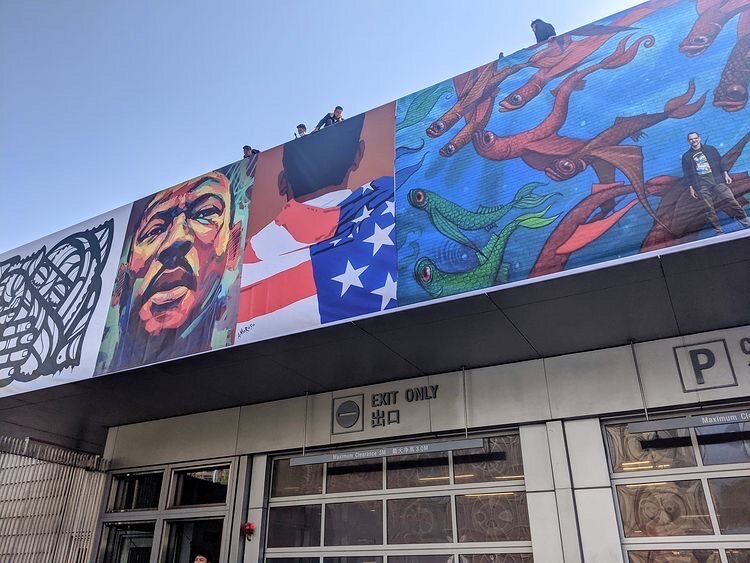
A few weeks later, she sent me these pictures and kept explaining things. But I could not wrap my head around what was going to happen.

Then I received the picture below, which was by far the most engaging and confusing of all of them.

scott_eagle_china.jpg

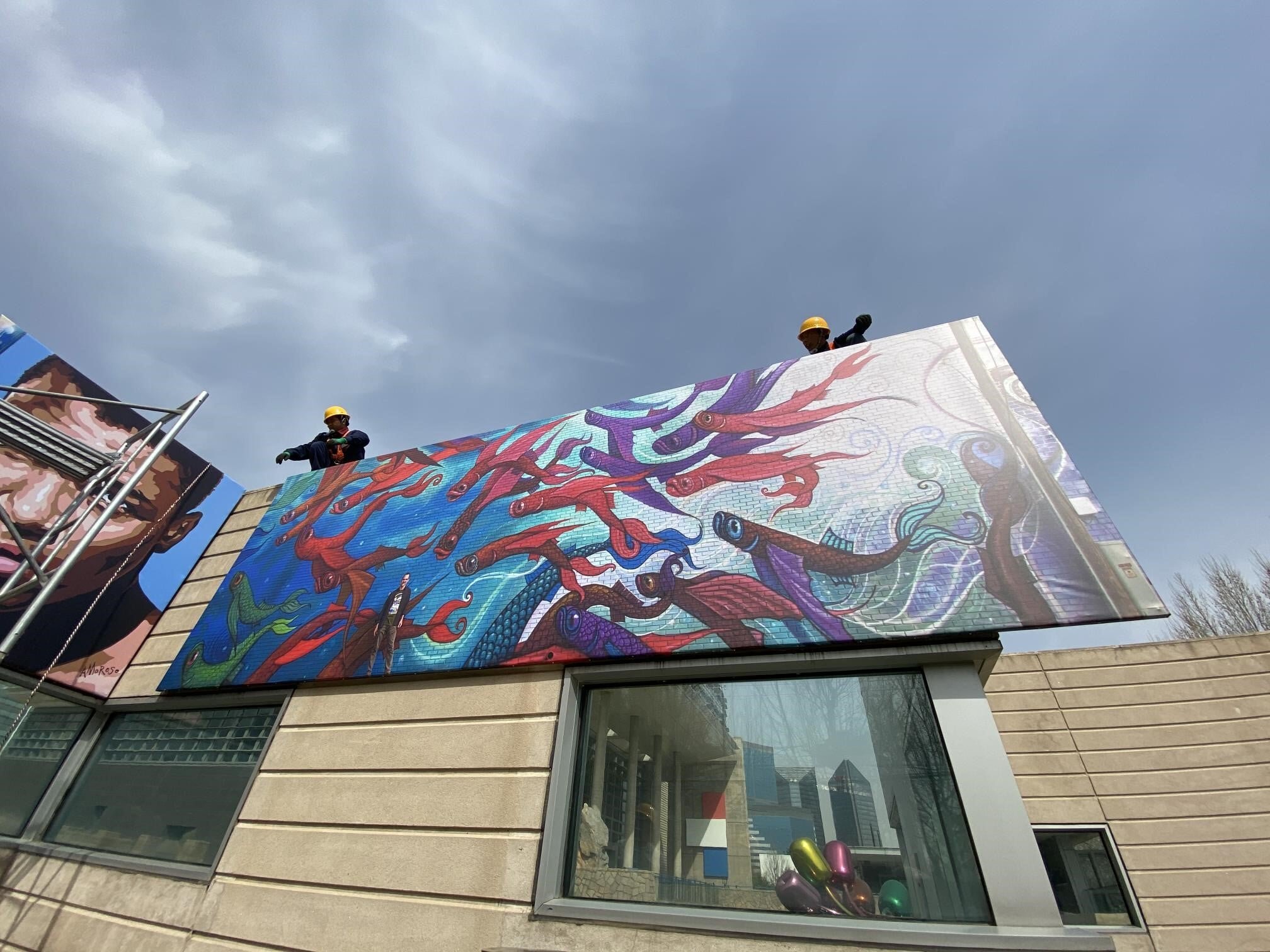
From her first inquiry, Sanny had said she wanted to reproduce the flying fish mural in China, so when I received these images from Daniel Kennington and Sanny, I thought that this was what she meant.

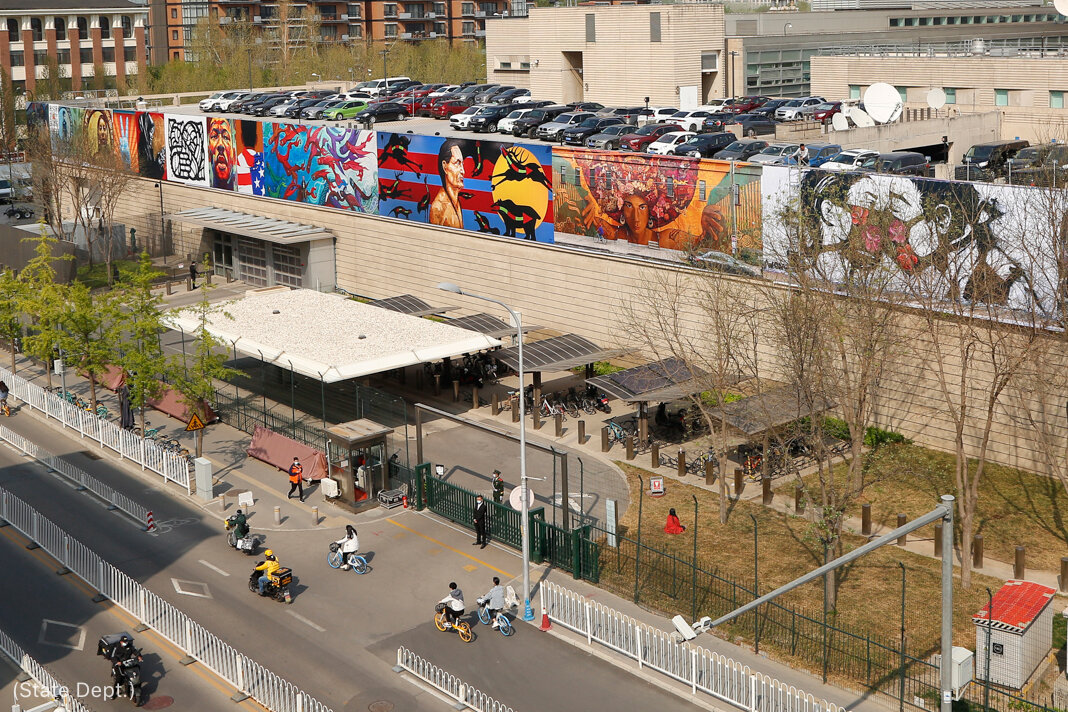
But then she sent these images.

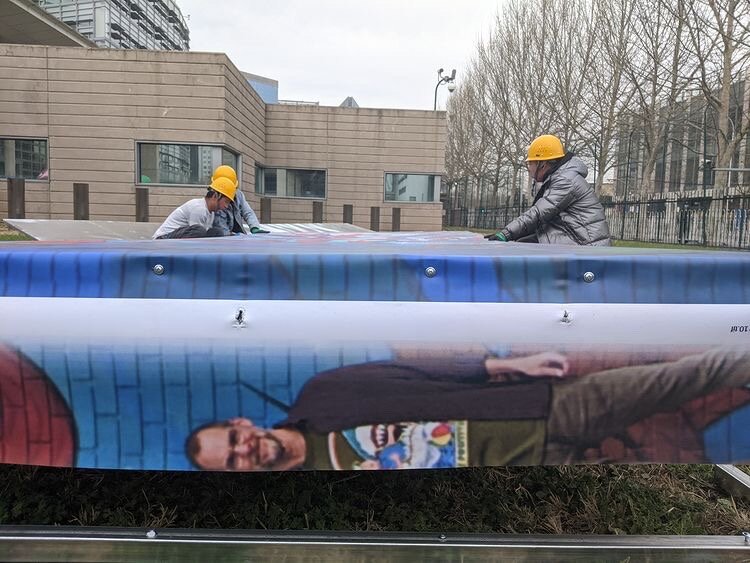
I have never been so confused and happy and overwhelmed by a series of events in my life. I am just incredibly lucky to have been included in ART FOR THE PEOPLE. My work, as well as 22 other murals are each reproduced twice around the US Embassy. One of mine is life size and is over the front door. THAT MEANS THERE ARE 2 OF ME IN CHINA RIGHT NOW 😳.

The U.S. Embassy in Beijing proudly announces the launch of Art for the People, a public art exhibit showcasing street art from the United States.  The Art for the People exhibition is the first of its kind to decorate the exterior walls of the Embassy compound.  This effort highlights the universal value of freedom of expression, as well as our ongoing commitment to direct engagement with the Chinese public.

Secretary of State Antony Blinken: “We want a U.S.-China relationship that includes space for direct, honest, and robust public engagement.  Art for the People represents the diversity of American society. It also embodies our deep commitment to genuine exchange with the Chinese people.”

American cities are home to countless examples of street art–some commissioned and some created organically.  All are part of a rich tradition of public art that proves art does not belong only in private museums or galleries.  Art is for the people, by the people, and represents public expression at its most fundamental.

The goal of street art is not always beauty; sometimes the art seeks to inspire reflection or spark public reaction.  Sometimes it is popular, sometimes it is controversial.  The point is to raise awareness of important issues that affect communities, such as immigration, police reform, or drug addiction. 

In showcasing 23 examples of street art we do not endorse any particular message.  The artists and works on display include the voices of immigrants and visitors to the United States and represent a range of political views and social commentary from communities across the country.  We are proud to create a window into this vibrant and critical part of American arts and culture.

The video below is a one minute timelapse video of the entire installation of all murals.

Thank you Sanny. You are amazing!

Sanny Wroblewski - Beijing, China

Sanny Wroblewski - Beijing, China

American Illustration + Exhibition Review = 🙌

twittermeme.jpg

It has been a good week!

The image above was selected as a finalist for the American illustration 38 competition, AI is the most prestigious illustration competitions for “cutting edge” illustration work

It was one of only 413 images selected from over 7,000 submitted. 

This year’s distinguished jury included: Chris Brand, Crown Publishing;  Hannah K Lee, The New York Times;  Janet Michaud, Politico;  Dennis Huynh, Buzzfeed;  Maria G. Keehan, Smithsonian;  Aaron Rinas, Art + Mechanical; and Marianne Seregi, National Geographic

I also had a blushingly wonderful write up in the Winston Salem Journal by Tom Patterson for my solo show at Delurk Gallery in Winston Salem including this quote;

 “Winston-Salem native Scott Eagle is one of North Carolina’s most skilled and thematically ambitious artists, as well as a professor of painting and drawing at East Carolina University’s School of Art and Design. His own work spans multiple mediums in its richly imaginative exploration of personal spirituality through imagery derived from mythology, art history, his dreams and his experiences in the waking world.“

WHY IS THIS A TWITTER MEME? IT LOOKS JUST LIKE A HUMAN BEAN (And what does that have to do with my mixed media drawing class?)

Twiitwr Meme

IF YOU DO NOT LIKE WORDS, SCROLL DOWN FOR LOTS OF PICTURES

This semester (Fall 2018) I taught my favorite class ART 3555 Mixed Media drawing. The class was originally created a hundred years ago by my mentor, friend and rock star Paul Hartley. About 50 years ago he scheduled me to teach that class for the first time and told me that the most important thing that students had to learn from that class was to play again. The reason I said “again” was that for the first three years of the curriculum, our students are drilled and critiqued and questioned to the point of exhaustion and sometimes even hating what they are making. Paul taught me, and what I hope my students take away from my class is that you have to give yourself permission to see the world as a child sees it. You have to try to look at a problem (any problem) without the blind, jaded adult filter on.

When I say adult filter, I mean the schema, framework and lens you have built in your mind to move you through the world toward the goal(s) that you have set for yourself or that others have set for you. The adult is supposed to be efficient and practical and get the job done. Have you ever heard of efficient or practical creativity?

ART 3555 is for juniors, seniors or first year graduate students because most of them have built up a healthy adult filter to survive the amount of work, and the repeated critiques of the quality of their work required to progress through an art and design degree. Those students have become efficient, practical and occasionally lazy with the pre-fabrication/brain storming/rough ideas for problems because they do not have a lot of time to complete assignments. They have great technical skills if they made it to this class, but the pre-fabrication/brain storming for the assignment is the most import part of the process and the easiest to skip. They have forgotten how to play.
I have observed that most students will use the first idea that pops into their head. If there are potentially an infinite number of solutions to a problem that I give, why in the world, would anyone assume that the very first one is the best? It is clearly the most obvious solution, but more important to this issue is that this is the way that we tend to look at any problem we encounter. We assume there is one answer and that the sooner we find, the sooner we can move on. That is a practical and efficient way to look at life.

On the first day of class, I say (basically) the following out loud, “In this class it is your job to play and have fun. Do not misunderstand that to mean goof off. You will work your ass off if you expect to pass. As long as you try to solve the essence of the problem, I give you permission to draw or paint or sculpt or video, etc., whatever subject matter you want and no one can criticize you for that choice. We can ask you why you made a particularly bizarre or even inappropriate image or object, but we cannot make a value judgement on your choice(s). If someone does challenge you, all you have to say is “Scott said I can do whatever I want”. That means you can paint unicorns, lighthouses, pirates, puppies, kittens with laser beam eyes, etc. It also means that if you make an image or object and you do not know why you did it, that is okay. You have my permission to say that you do not know, because I have learned that very frequently I make something and I cannot say what it means or why I did it. When you are really in the moment of making and spontaneously create something without the adult filter on, it is just like waking from a dream. It takes time to figure out what it means, or if it means anything important. And, most importantly, because it is your PERSONAL problem, we have no business placing a value judgement on what you just did.” I then give a demonstration and usually draw a unicorn with a lighthouse for it’s horn.

As you might imagine no one believes me at first. It is only after I enforce the play laws during the first project, that the most creative and/or sometimes the quietest students surprise us with amazing, or funny or bizarre things. Trust is the foundation of this course.

I also make things for this class (I do not hang my work at critiques) and require periodic trading of work with the possibility of not getting it back. I put my own artwork in these trades as well as former student’s work from this class. The image above comes from my solution to a problem called MULTIPLICITY;


MULTIPLICITY

Using the image you are working on for either the LIMINALITY project or the KRYPTONITE project; or both; or a project from another class; you will produce at least 10 variations of that image(s) using the techniques and technologies and parameters introduced in class.

MEDIUM


WIDE open. There are an infinite number of ways to use digital printing, traditional printmaking, photography, transfer techniques, scanning, and Photoshop, etc. as techniques for mixed media drawing, painting and ideation.

The objective is to use creative improvisation, new techniques, scanning, Photoshop manipulation, printing and/or any other duplication means on a variety of surfaces. Your goal is to encourage accidental and novel combinations of surfaces, techniques and images.


TECHNIQUES

I will demonstrate several techniques in class and provide you with links to others.

PARAMETERS

Your starting image should have a protagonist and antagonist. If you are working with a nonobjective image, a pattern or an abstraction, you will have to decide what is the protagonist and what is the antagonist before you begin.

1. At any size you wish, re-create the antagonist (or part of the antagonist) using techniques you have never used, using transfer techniques, by collaging, and/or by making it out of other things and taking a picture of it. Do at least 5 of these. WORK FAST!!!

2. Create an image where the protagonist from your original image is surrounded by, overwhelmed by, confused by, etc. different versions of, copies of, transfers of, etc. the antagonist that you created in #1.

3. Remove the antagonist from your original image then print the remaining image leaving room to redraw. Recreate the antagonist using a technique that you like but have never used before. Find a tutorial of this technique and share/submit to me.

4. Edit out the protagonist from your original image and redraw that image using a technique that you like but have never used before. Find a tutorial of this technique and share/submit to me. This can be a completely digital image.

5. Create a new image using any part(s) of the original.

6. Recreate or print the previous image on a new surface that either relates conceptually and/or changes the image’s meaning or readability

7. Recreate part or all of your original drawing in the real world. You could make a diorama, draw with masking tape, recreate as an installation, etc. You will record/submit this drawing as a video or photograph. It could be as sophisticated as this  or as "simple" as this.

8. Combine the image created in 7 with any part of an image from 1-6.

9. Combine any part or all of an image from 1-8 with any part or all of a different image from 1-9

SIZES


any


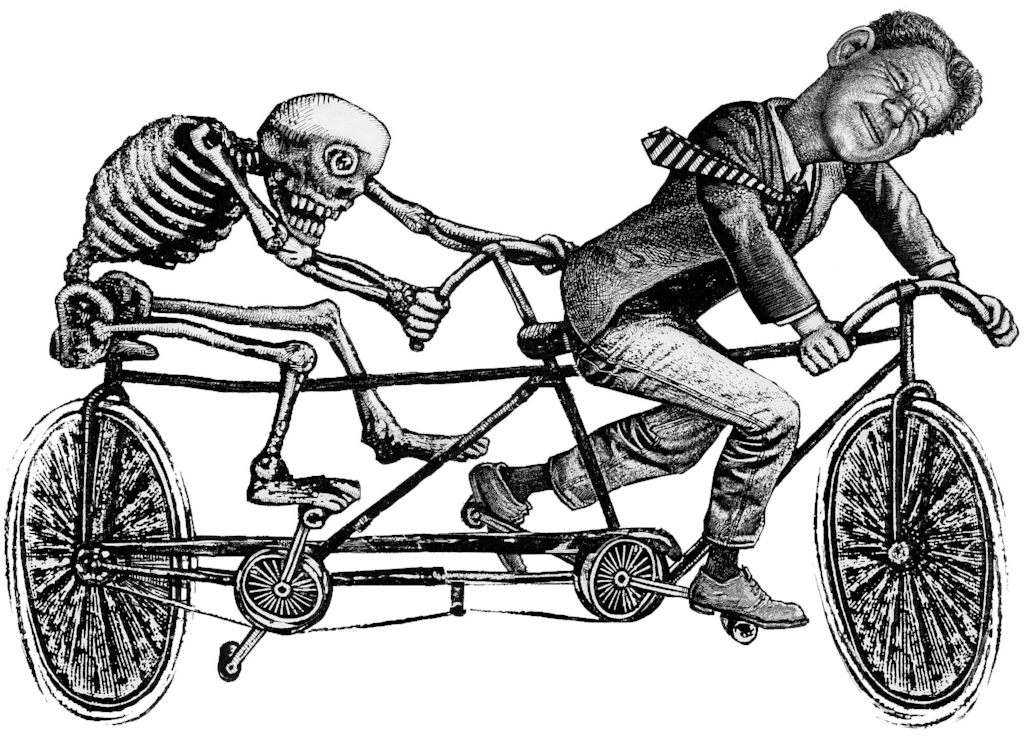
The image that I started out with was called The Lifecycle.

The Lifecycle
  • When I got to number 7, I decided to use just the skeleton’s skull.

skull.jpg
  • I started doing several of the numbers again using the the skull. For example, I took a photograph of a skull that used to hold the license plate to my car. See below.

Unknown-2.jpg
Geraniumcranium.jpg
pottedgeranium.jpg
cranium-with-geranium2.jpg
  • Then I thought about the series of severed heads that I did when I turned 40 about 15 years ago, like this one.

eyrie-1.jpg
  • Since I just stepped down from being an administrator last semester, I thought it quite relevant to visually let that part of me die so something new and hopefully beautiful could replace it. The images below are some of the things I made.

Face_Plant.jpg
IMG_4528.JPG
IMG_4991.jpg
skulflower.jpg
  • Then I started this larger pencil drawing. I got to the point below and really liked it but wanted to try something a little crazy with paint. I did not want to ruin what I had done so far, so I scanned it into the computer with the intention of printing a high resolution image to paint on instead.

IMG_4986.jpg
  • I decided to clean it up a little.

human-bean.jpg
  • And then I decided to see what a little color would look like.

human-bean-blue.jpg
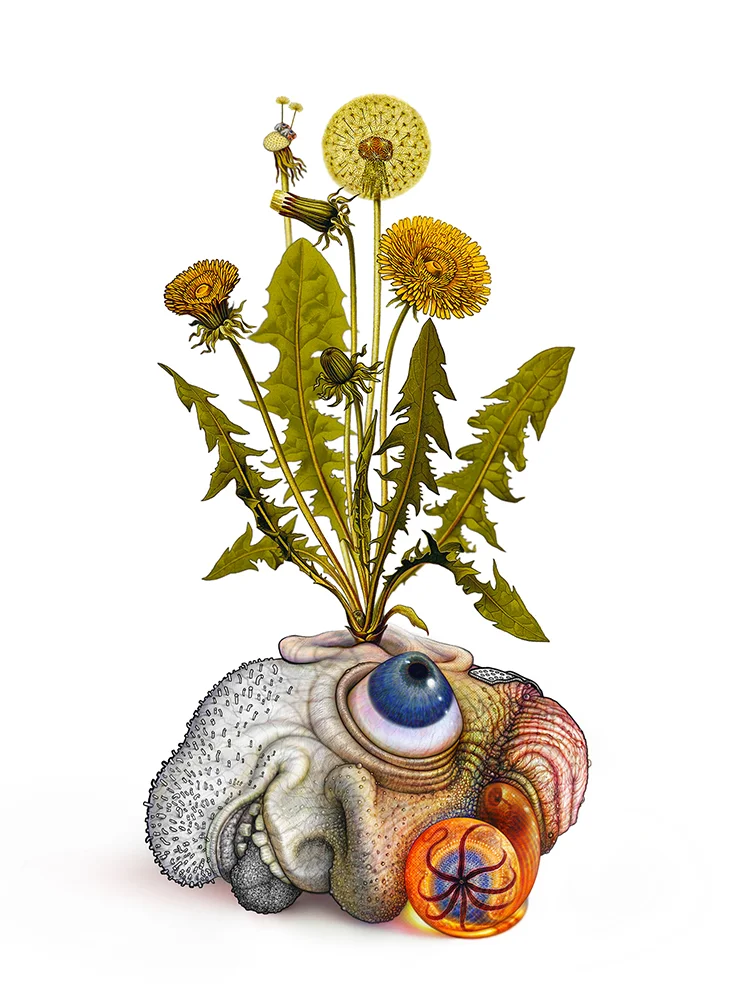
  • I liked the color so I added a little more. I had planned on using a day lily for the flower, but the eyes seemed both alive and dead. I jokingly named the file for this the “human bean” because the shape of the head reminded me of a bean. That also related to the idea that a seed, or bean, is a tiny corpse that eventually is reborn as a plant.

human-bean-flower.jpg
  • I added even more color. Bean rhymes with meme which is an element of a culture or system of behavior that may be considered to be passed from one individual to another by nongenetic means, especially imitation.

    • a humorous image, video, piece of text, etc., that is copied (often with slight variations) and spread rapidly by Internet users.

  • A meme is like a dandelion in the way that it spreads so quickly and easily across the digital landscape. The head that I created looks like it was once human, but it has now been invaded by something malicious. That thing has mutated and taken on the characteristics of its host.

human-beanorang.jpg
  • So why is this a Twitter meme?

Twitter is designed to spread encapsulated ideas, opinions and news rapidly and in one direction; forward. In my opinion, a great deal of that information has been malicious, and frequently false or misleading. Twitter has allowed for the propagation of a virus of intellectual laziness that has infected our entire culture. If you look closely at the human bean Twitter meme, you will see why IT is so dangerous. It has already begun it’s journey to a new host. Is that you?

Thinking Through Making

It is both an honor and privilege to be selected to speak at the 2018 Yuma Art Symposium. My topic will be Thinking Through Making which has become the collective mantra at East Carolina University School of Art and Design where I work.

My thesis for this presentation starts with the obvious; the creation of any "thing" requires an impetus or problem. But, once a problem is solved, there is no reason to continue making; right? So, for those of us that continue making, there must be some motivation behind our idiosyncratic iterations.

imagesdear-diary-gator.jpg

Sometimes we know exactly what the problem is and why we create.

tumblr_mnsvku8k9E1rphtnfo1_500.jpg

And we spend time and money to study our problem; and we learn about the history of our problem; and we meet people that have successfully confronted our problem;

725e5fd55ecbf8d6658044617c9b08f3--crocodiles-alligators.jpg

And they help us to control our fear and be confident of our skills; and they teach us to visualize our problem;

A+girl+walking+an+alligator+down+the+stairs,+c.+1960s.jpg

So that when we have finally mastered our problem...

vintage1920sphotographyalligatorsbaby.jpg

we are ready to face "THE REAL WORLD".

scott_eagle_lifecycle

But, as most of us know, life has different plans for us.

scott_eagle_shark_dream

And frequently, the problems we encounter are far worse than we had ever imagined.

scott_eagle_existenstial_crisis

And occasionally the objects that we have made force us to acknowledge that maybe the real problem has been right in front us, and we have not seen it.

scott_eagle_theology

So, with my presentation, I will explore how my creative process and personal problem solving have led me to the conclusion that maybe, just maybe, the things that we create are remaking us as we are making them.

The History Of Theology

Recently a patron asked me to explain the meaning of the image above. It is titled Theology and was completed over 15 years ago, but seems relevant now. This is an edited version of what I wrote and since it was originally written in one sitting, it jumps around chronologically like my mind does.

THEOLOGY

After I had received my MFA in 1992, I did not have a job and my wife was working full time as well as going to school. We had a brand new mortgage, a new baby and for several years I had been having recurring dreams about tornadoes that were inspiring paintings like the one below which was based on a print by The House Book Master called Death and the Young Man

At that time I was having physical and emotional problems that could not be explained. Many years later I would be diagnosed with generalized anxiety disorder. But that is another story.

At the same time I was working on the tornado paintings, I started the painting below titled Portrait Of A Man Wearing A Red Tarpon.

That image was inspired by the painting below by Jan Van Eyck titled Portrait of a Man Wearing a Red Turban.

Many scholars believe that this painting may be a self-portrait (which is what I would like to think). It is technically virtuosic, and depicts a man that appears pensive, but proud. The turban may be an allusion to worldliness. During Van Eyck's lifetime, the artist was a respected professional.

When I graduated from college, I had an amazing and incredibly patient wife, a beautiful, healthy daughter and we owned wonderful house with an fantastic mortgage payment. I was having severe panic attacks and anxiety that never stopped. I very seriously thought I was going crazy.

I was adrift in a liminal space between school and work; between childhood and being an adult; and even between being a mother or being a father because I did not have a full time job and my wife was the one supporting us. I was a stay at home dad at a time when no one else that I knew was doing that.

I had started painting the Madonna and Fish images while I was in college and continued to create variations in which I substituted a fish for the Christ child. The oil painting below is based on the Leonardo painting called the Madonna Litta.

As I am sure you know, early Christians had used the fish symbol (the "Ichthus") as a way to find out if they were communicating with another Christian. Today this secret symbol is on the bumper of most Christian's cars. It has become a brand that declares what team you are on. Most of the Christians that I have quizzed do not even know about the significance of that symbol.

The Madonna and Fish paintings and drawings were my attempts at creating an iconic image that depicted what I believed to be the feminine nurturing conception of the religious experience. It was maternal and required an unquestioning acceptance of the literal religious symbol to transcend the duality of human existence. The Madonna holding a fish was also intended to point out the absurdity of the love of a symbol devoid of humanity. 

I then tried to depict the way that I believed most men expressed their spirituality and religious beliefs. At that time I believed that we men intellectualize religion and wear it like armor to protect us from evil and/or the things we do not understand or agree with. I have observed men to be more interested in ideas and ideologies than human life and when we feel threatened, or when we want something, we use religion as a weapon to attack those whom challenge our faith or stand in our way. 

I created several images exploring that idea including the one below titled Study for Theology. 

Theology.jpg

It was inspired by the Leonardo drawing below which had the warrior's disposition I was trying to reference and call into question.

LEONARDO da Vinci, Profile of a warrior in helmet, c. 1472, Silverpoint on prepared paper

LEONARDO da Vinci, Profile of a warrior in helmet, c. 1472, Silverpoint on prepared paper

But it was not until I had left the idea for a while and finished a series of work on the Icarus and Daedalus myth as well as reading the book The Beak of the Finch: A Story of Evolution in Our Time by Jonathan Weiner that the final pieces fell into place.

Theology is the study of religious faith, practice, and experience, especially the study of God and of God's relation to the world. If God cast Adam and Eve out of the Garden of Eden, heaven is closed to us. We are separate from and cannot experience God directly except through death.  As far as I know, every religious text has been written by a human.

The drawing above depicts a man pointing to a piece of paper with instructions that illustrate how to fold an origami eagle. The man's image is based on Jan Van Eyck's self portrait. On top of his head sits a finch which, for me, alludes to Darwinism and the scientific method.

He is unaware of the real bird on his head and he is also unaware of the fact that the instructions that he confidently points to illustrate how to make a symbol for a bird and not a real bird. He has turned his back on the real world.  The environment, represented by the clear cut trees, is dead. It has been sacrificed to make the paper for his sacred text and for my drawing. The thing he worships, the eagle, has no place to live. As the world dies so does he. His scalp is as barren as the landscape.

The only things that break the boundry of his world are the finch, the origami instructions, and death (hair). Additionally, there are several things that I was thinking about that are probably not discernible to anyone else but me even after I explain them. For example; There are two steps intentionally missing from the origami instructions which is an allusion to the missing texts from the Bible. The wrinkles in the origami instructions used to look like a flower. The wrinkles around the theologians eyes are birds heads facing each other. His tie is an inverted tornado and anyone that has worn a tie knows that it is just a fancy noose. 

To emphasize the absurdity of this entire endeavor, the right hand corner of the window into the Theologian’s world is out of square and, instead, it is parallel to the wrinkle in the paper. The fact that the instructions to make the sacred bird refer to my last name is my acknowledgement and awareness that I, like any human, am limited to my own point of view which is based on the amount of information that I have at this moment in time. The eagle is also our national symbol and a symbol of patriotism and war which are diametrically opposed to the Christian conception of agape.

P.S. February 24, 2017 - The Madonna and Fish and Theology images represented the mother and father. Their child is Faith.

Faith    Charcoal on paper      1993

Faith    Charcoal on paper      1993


When Digital And Traditional Painting Meet

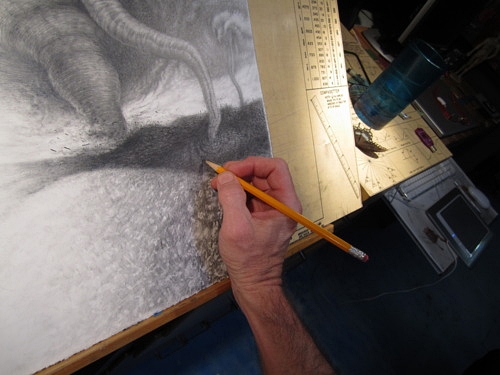
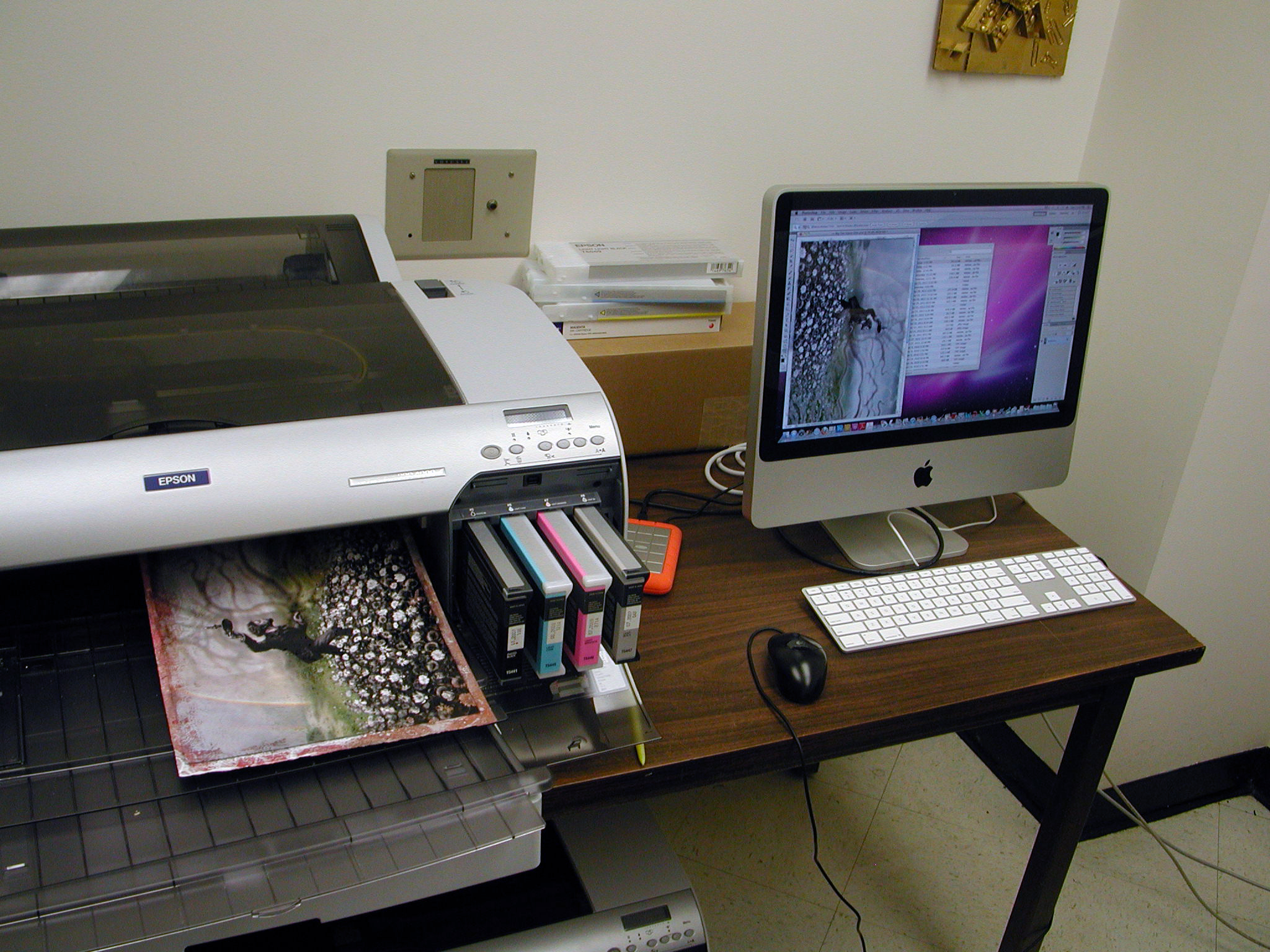
The following entry is a description of the mixed media digital printing and painting process that I have developed over the past few years. I work in many different mediums including acrylic paint, oil, mixed media, and purely digital. This is a heavily edited version of a previous blog post (The Adventures Of Icarus Elck) about the methods I used to create 30 unique mixed media prints for the ECU faculty exhibition in 2011. 

There are now acrylic mediums that can be applied to 2D surfaces to make them receptive to high quality archival digital printing. Once printed, these images can be sealed with UV varnishes to stabilize the surface making it possible to paint or collage on top of the image without releasing or lifting the water based, pigmented inks used to print the digital image. What is unique about the process I use is that I am painting back into these images with traditional paint and then running the print/painting back through the printer, sometimes multiple times. This process is unpredictable and causes accidents that inspire me to change the image. 

At that time I was creating the work described below, I was using a cheap Bamboo Wacom tablet (which has been completely redesigned and now is nothing like what is pictured below). I now use a Wacom 13' Cyntiq.

If you would like to see a sided by side comparison of digital and traditional painting, the video below is by our MFA Alumnus Jonathan Peedin, and was used during a presentation in October 2012 at the Southeastern College Arts Conference in Durham, NC. where he spoke at the invitational panel "Technologists, not Technicians: Integrating New Media in Art & Design"


THE ADVENTURES OF ICARUS ELK

Tornadoes have consistently appeared in my work since I started dreaming about them on March 29, 1989. For many years the dreams were terrifyingly vivid and often bordered on lucid. In many of those dreams I ran from the tornadoes, as did the characters in my paintings and drawings. At that time, my intention for this particular image was to finally turn and face the tornado.

I had begun this pencil drawing

with the intention of drawing a character, based on the clip art image below, walking in a field of poppies. I have been developing a personal/universal avatar called Icarus Elck. The image below is the first iteration of that character and was not the direction I ended up taking. I chose this particular image because it reminded me of Faust, and the expression, as well as the song, Candle In The Wind. I also saw it as a visual metaphor for the way a psychiatrist analyzes dream content, or the way an academic/traditional oil painter might think about digital painting.

I tried to shoot reference shots, but quickly realized that the anatomy of the original drawing is incorrect and I could not duplicate it. If you do not believe me, stand in front of a full length mirror and try to recreate the pose exactly. I promise you that if you have children or a roommate, they will walk into the room the moment you do this.

I liked the obviously dated, black and white drawing, so I decided to just use the image exactly. In the Artworld, it is called "appropriating". In music it is called "sampling". When somebody does it to you, it is called stealing. :  ) Remember - Everything Is A Remix

I was not happy with the intestine like tornado in the original drawing, nor with the beginnings of the poppy field.

So, I scanned the drawing into the computer and edited out the intestinal tornado.

I wanted poppy fields for their link to tornadoes that I had grown up with and for their tie to mind altering drugs and the war in Afghanistan. 

I chose this iconic scene and edited out the characters as well as desaturated colors and mirrored the image. The black and white landscape that resulted reminded me of old postcards of tobacco fields in North Carolina.

cJzGXDAxmsdIdC5cXehi-KuRV0j2_cSefB6gOl2cgO0Xg65m9kSSzikyTA5bar8cy8aiKy1zlqvjCA=w880-h440.jpg

I introduced the man, and decided to add a few flowers.

Here are some early test prints.

At that time I was teaching myself how to use Photoshop and got carried away with layers and the digital drawing process. 

Believe it or not, I start every image by saying “This time I will not get obsessed with minutia.”

Below is a studio shot of some of the different versions at various stages of completion.

Here is a weird one that I like.

A shot of the actual printing.

My studio Friday, October 7, 2011. The day the paintings were due to the gallery.

The 30 best ready to be hung.

Installed.

This particular image has continued to evolve and change over the years and now that you have seen how it began, you can probably see how it is related to these images;


“God Bless America”

scotteagle_godblessamerica


The image God Bless America is intended to do what the statement “God Bless America” does. It appears to be a rallying cry and statement of unquestionable moral allegiance and righteousness. But in reality it is an amalgamation that just won’t fly. Picture in your mind what will happen when the eagle (America) takes flight. Christ (God’s moral authority) will be turned on his head and become an abomination.

Religion is an anchor for the soul in a world of chaos. Nations and states are arbitrary geographical regions and change frequently. “God Bless America “ makes us feel patriotic and morally just in our actions, but it is actually an incredibly selfish statement that says God loves my arbitrary geographical region more than your random geographical region.

What about the rest of the universe for God’s sake : )

Tiny Tim from "A Christmas Carol" says "God Bless Us, Everyone" http://videoquoter.com/

I FINALLY HAVE A WEBSITE

A GREAT BIG THANK YOU TO ERIKA GIBSON for taking time away from her ceramics to put together a website that I could actually update all by myself at any time and not have to ask her to do it for me. I LOVE IT!  For some reason she seemed really happy to do this.      

Visit her WEBSITE and/or follow her on INSTAGRAM


ALSO, A GREAT BIG THANK YOU TO TODD COATS. He has devoted literally years to solving my impossible requirements for a new identity (why are you laughing?) and successfully created a branding that is the most amazing, huge, smart, and whatever other Trumpian adjective you care to insert here or anywhere. He has worked under such duress that it will deserve it’s own blog post.

Here he is teaching David Letterman how to use post-it notes.

In March, 2006, My boss, Todd Coats. and I traveled to New York to be on the Late Show with David Letterman. There, we created a likeness of stage manager Biff Henderson out of Post-It Notes. This is a montage of the clips coming in and out of commercial, with the introduction and reveal of the final product.


INFORMATION ABOUT THE WORK. The titles for the groups of images refer either to the title of a consistent body of work, or to the idea driving the creative process behind the work in that group. For example The Search will be where I post my doodles. They usually begin with no conscious intent and simply evolve as I search for their meaning. The Found are images that have significant meaning to me. I will devote future blog posts to the explanation of some of those works.

Finally, this site is organic and will change. I am still working on the FENG SHUI-ing. So, if you have suggestions on how I can make your experience more zenful, please let me know. 

  1. ✔️ Encourage helpful people in your life by hanging a pleasant-sounding wind chime. 
  2. ☐ Place an energetic fountain near your front door.  
  3. ✔️ Clear the entryway to your home. 
  4. ✔️ Make sure your home encourages learning. 
  5. ✔️ Get rid of unwanted frustrations by fixing broken objects. 
  6. ✔️ Spice up your love life with plants in the bedroom. 
  7. ✔️ Position your bed to feel safe, loved, and great.
  8. ☐ Block drains to keep dollars from draining out of your pockets. 
  9. ✔️ Boost your career with a better desk position

Keep "meditating" for up to 15 minutes. APPLE: http://apple.co/1Kb4x7N | ANDROID: https://play.google.com/store/apps/details?id=com.jasonheadley.hnestmeditation Get the book: http://bit.ly/1WnTWit


Wonderbook: The Illustrated Guide to Creating Imaginative Fiction

WONDERBOOK
The Illustrated Guide to Creating Imaginative Fiction
By Jeff VanderMeer

I have been included in an amazing writing guide that uses hundreds of images by artists and illustrators as inspiration for creative writing.

I have 4 artworks used as illustration on seven pages, an interview and even a full page picture of my studio shelves.

Jeff VanderMeer,  award-winning author of The Steampunk Bible, has taken a completely new and wholly original approach to the writing guide, and created a manual that not only utilizes invaluable written information, but also teaches via scores of helpful and stimulating illustrations. Through an accessible, example-rich approach that emphasizes the importance of playfulness as well as pragmatism, Wonderbook energizes and motivates while also providing practical, nuts-and-bolts advice about how to improve as a writer. The book is filled with more than 200 images and pictorial exercises that will expand the reader’s creativity. These imaginative and influential illustrations are sure to inspire the next generation of aspiring fantasy writers.

Read more…